





Table of Contents
- 1 Understanding Public Affray in Georgia
- 2 Disorderly Conduct and Related Offenses
- 3 Mutual Combat and Its Legal Implications
- 4 Self-Defense and Stand Your Ground Laws
- 5 Consequences for Students Involved in Fights
- 6 Impact of Public Fights on Criminal Records
- 7 Preventive Measures and Conflict Resolution
- 8 Conclusion
Understanding Public Affray in Georgia
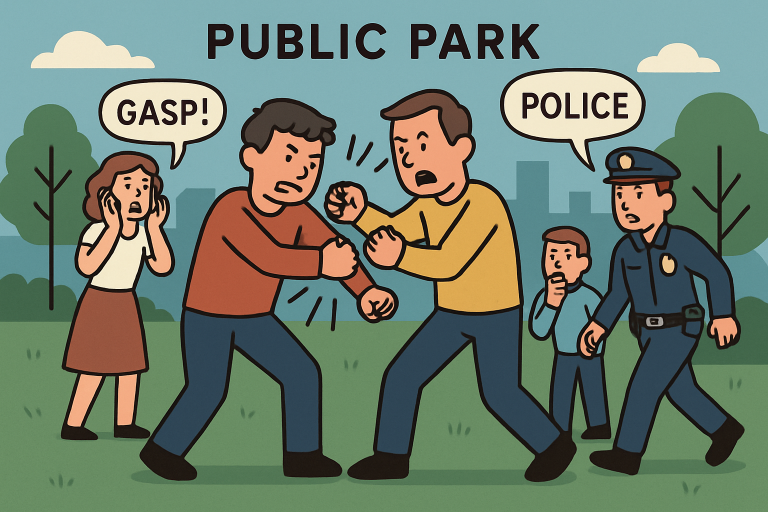
Georgia law treats fighting in public as a serious offense under the charge of public affray. The legal definition, outlined by Georgia Code § 16-11-32, characterizes affray as an altercation involving two or more persons in a public space that disrupts public peace. Public tranquility is central to this law, and charges typically hinge on whether the fight indeed caused a disturbance.
If convicted of public affray, individuals face misdemeanor penalties of up to 1 year in jail and fines of up to $1,000. Consequences may vary depending on the circumstances and severity of the incident. For those facing such charges, securing legal representation and exploring resources like brianhobbslaw.com can provide crucial guidance and defense strategies.
It’s important to understand that even if all parties involved in the fight are willing participants, the act itself can disrupt the peace, resulting in police intervention and criminal charges. Authorities often consider factors like bystander complaints, the use of weapons, or the escalation of violence when determining charges.
Notably, a fight need not involve injuries to rise to the level of criminal affray. Verbal altercations that quickly escalate or those conducted in public view may also qualify if they threaten the community’s sense of safety.
Disorderly Conduct and Related Offenses
In addition to public affray, Georgia law criminalizes disorderly conduct—an umbrella charge that covers a range of disruptive or threatening behaviors. Under Georgia Code § 16-11-39, disorderly conduct involves violent actions, making threats, or using abusive language with the intention of provoking violence. This statute aims to address situations in which actions may intimidate or endanger those nearby, even if a physical fight does not occur.
Penalties for disorderly conduct mirror those for affray, often resulting in misdemeanor convictions with jail terms of up to a year and fines. Minor disputes that spiral out of control can easily lead to charges if witnesses call law enforcement or if there’s property damage. In cases involving weapons or significant threats, charges may be elevated, bringing more serious consequences. More details on this statute are available at FindLaw. A disorderly conduct charge can still have lasting consequences beyond immediate fines or jail time, including a permanent criminal record that may affect employment or housing opportunities. Because these cases often rely heavily on witness accounts and officer discretion, understanding your rights and seeking proper legal guidance is crucial when facing such allegations.
Mutual Combat and Its Legal Implications
Georgia recognizes the concept of mutual combat—when two or more people willingly engage in a fight. However, mutual agreement to fight does not exempt the parties from criminal liability. The law does not allow citizens to settle disputes through violence, even if both sides agree. Charges like affray or disorderly conduct may still be filed in these cases.
Courtrooms evaluate mutual combat situations by considering whether the confrontation was truly consensual and whether there is evidence of prior agreement. Injuries, the presence of weapons, or participation by bystanders can escalate the situation into more serious offenses, such as aggravated assault or aggravated battery, which are felony charges. The complexities of mutual combat underline the importance of understanding and respecting the law’s intent to protect public safety.
Self-Defense and Stand Your Ground Laws
Georgia’s Stand Your Ground law provides individuals the right to use force to defend themselves without the obligation to retreat, given that they have a reasonable belief they are in imminent danger. However, this justification is not carte blanche—individuals may not provoke an altercation and then claim self-defense if they become the aggressor. Additionally, the law does not allow for deadly force if only property is at risk or if the use of force is disproportionate.
Courts in Georgia scrutinize claims of self-defense, considering evidence, witness testimony, and whether the response matched the threat level. Misusing the self-defense claim can lead to criminal liability or even additional charges. Georgia Public Broadcasting provides a detailed breakdown of how the stand-your-ground statute works in practice and its legal boundaries.
Consequences for Students Involved in Fights
Students who engage in fights at school risk not just criminal charges but also academic disciplinary actions. While Georgia’s Supreme Court has clarified that students cannot be expelled for fighting if acting in apparent self-defense, schools retain broad authority to suspend or discipline students involved in violent altercations. This distinction makes it especially important for students and parents to understand school policies and the state’s legal standards for self-defense.
Impact of Public Fights on Criminal Records
Being convicted of affray, disorderly conduct, or related crimes in Georgia can leave a lasting mark on a person’s criminal record. These convictions may hinder job prospects, affect college or scholarship applications, and even impact the ability to secure housing. The stigma surrounding a violent offense can follow an individual long after any fines are paid or jail terms are served. Record expungement may be an option in some cases, but it often requires legal assistance and court approval.
Preventive Measures and Conflict Resolution
The best way to avoid the severe, lasting repercussions of a public fight is to use nonviolent conflict-resolution strategies. Mediation, counseling, and open communication are effective ways of managing disputes before they escalate. Many communities in Georgia offer resources and programs to promote peaceful conflict resolution, fostering safer environments for all residents.
Conclusion
Engaging in or provoking a fight in public in Georgia can have profound legal and personal consequences, from jail time and fines to long-term effects on your reputation and opportunities. Understanding the legal distinctions between affray, disorderly conduct, mutual combat, and self-defense is vital. Avoiding violence and seeking peaceful solutions is the safest way to protect yourself and your future from the risks associated with public fights.


