




Industrial adhesives are entering a new era shaped by significant advancements that meet the evolving demands of today’s manufacturing sector. The relentless push for efficiency, sustainability, and product integrity is steering innovation and making adhesives a critical component in diverse industries such as automotive, aerospace, electronics, construction, and consumer goods. Modern manufacturers now increasingly rely on advanced adhesive technologies to enhance product performance, streamline assembly processes, reduce operational costs, and ensure long-term reliability. Companies such as Leech Adhesives are at the forefront of these developments, offering cutting-edge solutions tailored to contemporary manufacturing needs. These enhanced adhesives are more than just bonding agents; they offer a host of mechanical, chemical, and functional properties that significantly contribute to the manufacturing value chain.
The adhesive industry is evolving beyond basic bonding to meet consumer expectations and regulatory pressures. Manufacturers now seek strong, durable, and eco-friendly adhesives that perform under extreme conditions and integrate with digital technologies. This shift towards more innovative, greener manufacturing grants businesses a competitive edge and aligns with global sustainability goals, enabling them to respond swiftly to market demands while delivering quality products.
Table of Contents
Sustainable Adhesive Formulations
The demand for eco-friendly manufacturing across global industries has prompted the rapid adoption of bio-based adhesives and low-VOC (volatile organic compounds) adhesives. These innovations significantly minimize the release of hazardous substances into the environment, supporting worldwide efforts to reduce industrial emissions and promote cleaner air. Leading adhesive manufacturers have introduced eco-conscious product lines that use renewably sourced polymers, bio-resins, and environmentally responsible solvents, aligning with high-profile initiatives such as the European Union Green Deal and the United Nations Sustainable Development Goals. According to a report by Henkel AG, the introduction of bio-based polyurethane adhesives containing more than half renewable content demonstrates tangible progress toward sustainability. It offers viable alternatives to traditional petrochemical-based products.
This ongoing trend is influencing not only the underlying chemical compositions and raw material sourcing of adhesives but also the operational standards and practices of manufacturers. Regulatory agencies across Europe, North America, and Asia are setting increasingly strict limits on allowable emissions and hazardous material content, pushing further innovation. These steps are pivotal for helping manufacturers address rising consumer demand for greener solutions while ensuring ongoing compliance with evolving environmental regulations. Businesses interested in deepening their understanding of the broader environmental impact and lifecycle of adhesives can explore independent scientific coverage in ScienceDirect. Adoption of sustainable adhesives is thus becoming fundamental to modern manufacturing strategy.
High-Performance Adhesives for Extreme Environments
As manufacturing applications diversify, so too must the adhesives used to assemble products destined for high-stress or harsh-condition environments. Industries such as automotive, aerospace, electronics, and renewable energy require adhesives that maintain their bonding integrity under extreme heat, pressure, vibration, chemical exposure, and even in wet or underwater environments. Recent advanced formulations are making this possible, offering heat-resistant adhesives capable of service well above 300°C, UV-curable products that set rapidly and deliver outstanding weather and corrosion resistance, and structural adhesives that bond dissimilar materials like metals, plastics, and composites together with exceptional strength. These specialty products are now considered indispensable for sectors where long-term safety, operational integrity, and performance cannot be compromised. By integrating high-performance adhesive solutions into their designs, manufacturers can push the boundaries of material engineering and produce lighter, stronger, and more efficient products.
Innovative Adhesives with Sensing Capabilities
Intelligent adhesives equipped with embedded sensors and integrated electronic components exemplify a significant leap forward in industrial bonding. These new-generation materials can actively monitor structural health by detecting real-time shifts in stress, strain, or temperature at the adhesive joint. The valuable data generated allows manufacturers to predict maintenance needs, schedule repairs before issues escalate, and extend the safe lifespan of products. This proactive maintenance approach, driven by real-time information, reduces failures, downtime, and operational costs across the manufacturing, construction, automotive, and transportation industries. Recent advances in materials science allow such sensors to be integrated directly into adhesive films or beads without compromising core bonding strength or functionality, as highlighted in the Nature Scientific Reports. In the coming years, the integration of innovative adhesives may become standard in mission-critical sectors to ensure safety and quality throughout a product’s life cycle.
Automation in Adhesive Application
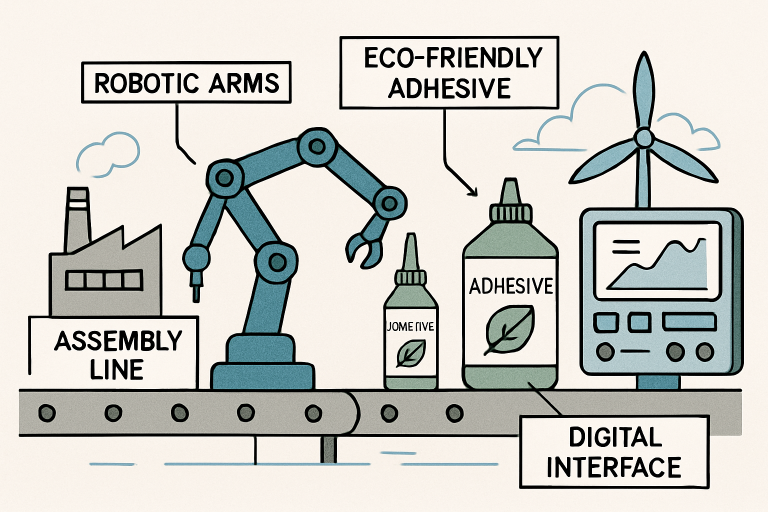
Precision and speed have become essential attributes of modern assembly lines, making automation and robotics integral to high-volume adhesive application. Automated dispensing systems can deliver highly consistent, repeatable bead profiles, drastically reducing material waste and lowering labor costs compared to manual processes. Robots equipped with sophisticated end-effectors can reliably apply adhesives to components with complex geometries, intricate assemblies, or hard-to-reach locations, ensuring the integrity of the final product and creating stronger, more durable bonds. The use of automated systems reduces human error, enhances workplace safety, and enables higher throughput, all key objectives for leading manufacturers worldwide. By integrating intelligent automation with flexible adhesive solutions, manufacturers can respond even more quickly to changes in production schedules, customer demand, or design engineering requirements.
3D Printing of Adhesives
In recent years, 3D printing has moved far beyond simple prototyping and is increasingly used to manufacture custom adhesive formulations with unique physical, mechanical, and chemical properties. By leveraging additive manufacturing, producers can now develop adhesives that are evaluated and adjusted on a per-application basis, tailoring properties such as elasticity, viscosity, cure rate, tensile strength, electrical conductivity, and chemical compatibility to match particular production needs. The use of 3D-printed adhesives opens the door to truly innovative product designs, allowing engineers to select or even specify single- or multi-component bonding solutions that deliver outstanding, application-specific performance in advanced sectors such as aerospace, electronics, automotive manufacturing, and medical devices. This trend is expected to grow rapidly as additive manufacturing and digital production technologies are increasingly adopted across industries worldwide.
Conclusion
As the industrial adhesives landscape evolves at an unprecedented pace, manufacturers now have access to increasingly innovative products and materials capable of solving even the most demanding technical challenges. From breakthroughs in sustainable chemistry and raw material sourcing to the integration of digital sensors, automation, and additive manufacturing, the latest adhesive trends position these essential materials as true enablers of modern manufacturing. These developments not only help improve process efficiency and end-product quality but also support the global drive for greener, smarter, and more resilient industrial solutions. Staying ahead of these technological and sustainability trends will be essential for any manufacturer committed to remaining both competitive and responsible in an ever-changing world.