




Table of Contents
Understanding Specialized Manufacturing & Engineering

The landscape of industrial production is vast, but within it lies a distinct and highly specialized segment: specialized manufacturing and engineering. This area is fundamentally different from general manufacturing, which often focuses on high-volume, standardized production. Specialized manufacturing, by contrast, thrives on complexity, customization, and precision, often operating at lower volumes but with significantly higher technical demands.
Defining Specialized Manufacturing & Engineering
At its core, specialized manufacturing and engineering is about creating components, assemblies, or systems that require a high degree of technical expertise, custom design, and meticulous execution. It’s not about mass-producing identical items; it’s about crafting unique solutions for specific, often critical, applications.
Key characteristics that define this sector include:
- Low-Volume Production: Projects typically involve smaller batches, ranging from single prototypes to a few thousand units, rather than millions. This allows for greater attention to detail and customization.
- High-Complexity Components: The parts and systems produced are often intricate, with tight tolerances, advanced material requirements, and complex geometries that demand sophisticated manufacturing processes.
- Custom Engineering: A significant portion of the work involves custom design, engineering, and problem-solving, often in close collaboration with the client’s R&D teams. This extends beyond merely building to print, often involving design analysis and optimization.
- Rapid Prototyping: The ability to quickly iterate on designs and produce functional prototypes is crucial. This allows for testing and verification before committing to final production, significantly de-risking projects.
To illustrate the distinction, consider a comparison:
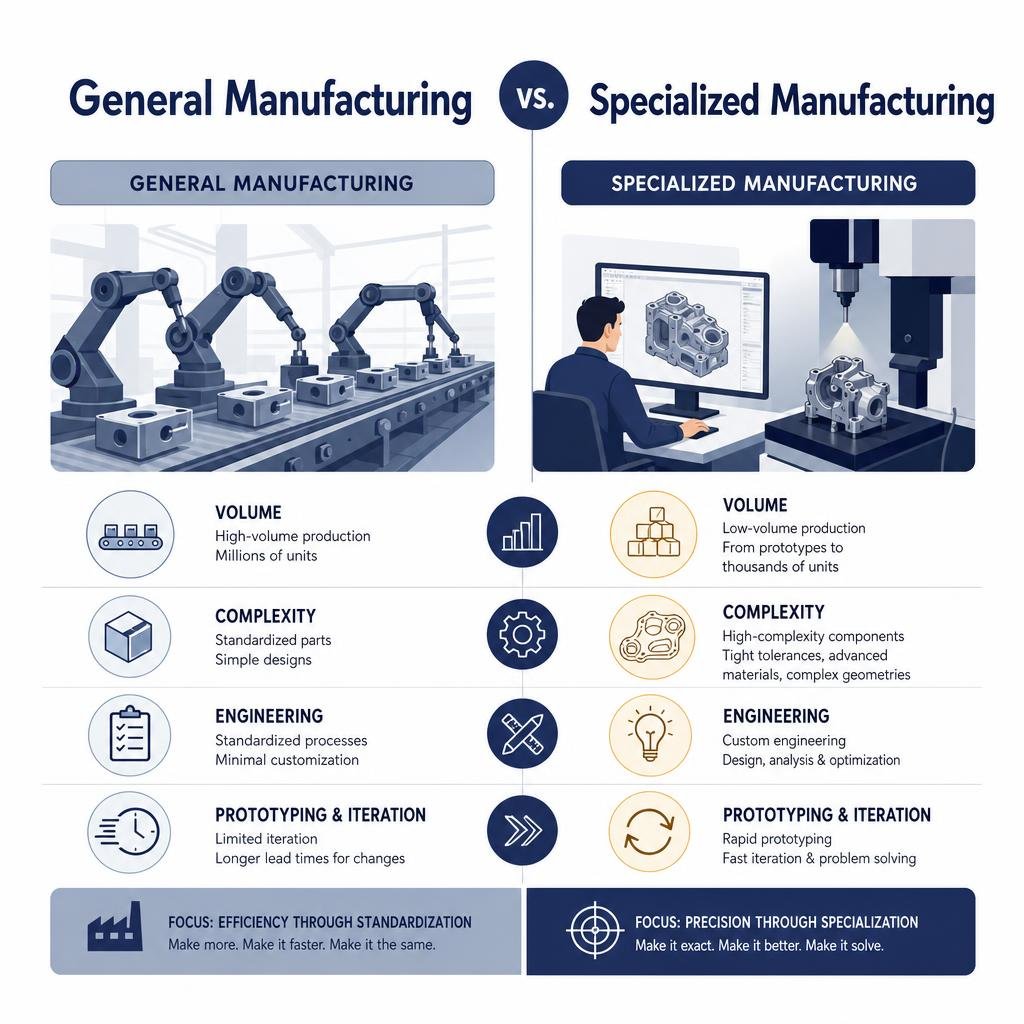
While general manufacturing aims for efficiency through standardization, specialized manufacturing excels by providing bespoke solutions that meet exacting performance requirements.
Core Capabilities and Services
Companies operating in the specialized manufacturing and engineering sector offer a comprehensive suite of services designed to tackle the most challenging projects. These capabilities are often integrated in-house, allowing for seamless project execution and stringent quality control.
Among the most common and critical services are:
- CNC Machining: Computer Numerical Control (CNC) machining is foundational. This includes multi-axis milling (e.g., 3-axis, 5-axis), turning, and grinding, capable of producing highly precise parts from various materials. Modern 5-axis machines, for instance, can achieve accuracies up to 0.008 mm, crucial for aerospace and medical components.
- Sheet Metal Fabrication: This involves transforming flat metal sheets into desired shapes through processes like laser cutting, bending (using CNC press brakes), punching, and forming. The ability to handle diverse metals like aluminum, steel, and stainless steel with precision is paramount.
- Laser Cutting and Engraving: High-power fiber lasers and CO2 lasers are used for cutting intricate shapes in various materials, as well as for precise engraving for part identification or aesthetic finishes.
- Precision Welding: Techniques such as MIG and TIG welding are employed for joining metals, often for structural components or sealed enclosures, requiring highly skilled operators to maintain integrity and aesthetics.
- Cable Harness Assembly: For complex electronic systems, the meticulous assembly of custom cable harnesses and wire looms is essential. This involves precision wire preparation, expert soldering, and rigorous testing to ensure high reliability, especially in mission-critical applications.
- Electro-Mechanical Integration: Beyond individual components, specialized manufacturers often integrate electrical and mechanical sub-assemblies into complete systems, including control panels, breakout boxes, and complex electro-mechanical devices. This requires expertise in both disciplines and careful management of interfaces.
- Additive Manufacturing (3D Printing): Industrial-grade 3D printing, particularly Selective Laser Sintering (SLS) and metal additive manufacturing, is increasingly vital for rapid prototyping, creating complex geometries, and even producing functional end-use parts, offering advantages over traditional FDM methods for serious manufacturing.
These capabilities, when combined with robust engineering support, allow specialized manufacturers to take ideas from concept to reality, providing critical support to industries where precision and reliability are non-negotiable.
Critical Quality Standards and Certifications
In specialized manufacturing and engineering, the stakes are often incredibly high. Components might be destined for an aircraft, a life-saving medical device, or a critical defense system. In such environments, “good enough” is never sufficient. This necessitates adherence to rigorous quality standards and certifications that dictate every aspect of design, production, and testing. These certifications are not merely badges; they are comprehensive frameworks that ensure consistency, reliability, and safety.
Aerospace and Defense Compliance
The aerospace and defense sectors are arguably the most demanding when it comes to manufacturing quality. The consequences of failure can be catastrophic, leading to loss of life, mission failure, or significant financial setbacks. Therefore, specialized manufacturers serving these industries must demonstrate unwavering commitment to established standards.
- ISO 9001:2015: This is the international standard for quality management systems (QMS). While not industry-specific, it provides a foundational framework for ensuring that organizations consistently meet customer and regulatory requirements and are committed to continuous improvement. For specialized manufacturers, an ISO 9001 certification ensures a systematic approach to quality throughout every project stage.
- AS9100: Building upon ISO 9001, AS9100 is the aerospace industry’s specific QMS standard. It incorporates additional requirements critical for aerospace safety and reliability, including configuration management, first article inspection, and control of nonconforming product. Certification to AS9100 is often a prerequisite for suppliers in the aerospace and defense supply chain.
- MIL-SPEC (Military Specifications): These are standards developed by the U.S. Department of Defense to ensure products meet specific performance, reliability, and interoperability requirements for military applications. Compliance with MIL-SPEC often dictates material choices, manufacturing processes, and testing protocols for components used in defense systems.
- ITAR Compliance: The International Traffic in Arms Regulations (ITAR) govern the export and import of defense-related articles and services. Specialized manufacturers working on defense projects must be ITAR compliant to protect sensitive technological information and ensure national security. This often involves strict controls over data access, employee background checks, and secure facilities.
Many clients actively seek partners who offer US-made manufacturing and engineering services, not just for logistical advantages but also for the assurance of adherence to these stringent domestic and international standards. This preference is driven by factors like intellectual property protection, supply chain resilience, and direct oversight of quality processes.
Specialized Manufacturing & Engineering in Semiconductor Lithography
The semiconductor industry presents its own unique set of challenges, particularly concerning contamination control and precision. The fabrication of microchips involves processes at the nanoscale, where even a microscopic particle can render a device unusable. Specialized manufacturing and engineering in this domain demand an almost obsessive focus on cleanliness and environmental control.
- Contamination Control: This is paramount in semiconductor manufacturing. It involves maintaining ultra-clean environments (cleanrooms), using specialized materials that do not shed particles, and employing processes that minimize the introduction of contaminants.
- SEMI E111 & SEMI E112: These are standards developed by SEMI (Semiconductor Equipment and Materials International) that address specific aspects of equipment and material handling within semiconductor fabs. For example, SEMI E111 focuses on specification for automation requirements for reticle management, while SEMI E112 deals with specification for automated reticle handling systems. Adherence to these standards ensures compatibility and efficiency in highly automated fabrication plants.
- Reticle Protection: Reticles are photomasks containing the patterns transferred onto semiconductor wafers. They are extremely sensitive and expensive. Specialized manufacturers design and produce protective enclosures for these reticles, ensuring they remain free from damage and contamination during transport and storage. For instance, Microtome specialized SEMI pods are designed to provide an ultra-clean, protective environment for these critical components, preventing particle contamination and mechanical damage.
- Faraday-Cage Shielding: In sensitive electronic environments, particularly in semiconductor testing and handling, protection against electromagnetic interference (EMI) is crucial. Faraday-cage shielding involves creating an enclosure that blocks electromagnetic fields, protecting sensitive components from external noise and preventing internal emissions from interfering with other devices.
- Electric Field induced Migration (EFM): This phenomenon, also known as electromigration, refers to the transport of material caused by the gradual movement of the ions in a conductor due to the momentum transfer between conducting electrons and the diffusing metal atoms. While not a standard itself, specialized engineering in semiconductors often involves designing components and processes to mitigate EFM, which can lead to device failure over time.
These specialized requirements underscore the depth of expertise required in certain niche areas of specialized manufacturing, where the engineering challenges extend far beyond typical mechanical precision.
Advanced Technologies Shaping the Industry
The specialized manufacturing and engineering sector is a crucible of innovation, constantly adopting and refining advanced technologies to push the boundaries of what’s possible. These technological advancements are not just about making things faster or cheaper; they’re about enabling entirely new product capabilities, enhancing reliability, and streamlining complex design-to-production workflows.
Additive Manufacturing and Hybrid Workflows
Additive Manufacturing (AM), commonly known as 3D printing, has moved far beyond prototyping and is now a critical tool for serious manufacturing. Its impact on specialized engineering is profound, particularly in creating complex geometries and optimizing performance.
- Selective Laser Sintering (SLS): Industrial SLS 3D printers, such as the Formlabs Fuse 1+ 30W, allow for the production of strong, functional parts with excellent mechanical properties. Unlike basic FDM printers, SLS can create parts with intricate internal structures and fine details, making it ideal for low-volume production and complex components.
- Monolithic RF Structures: A groundbreaking application of AM is in the creation of monolithic radio frequency (RF) structures. By printing components like waveguides, filters, and antennas as a single, seamless unit, engineers can eliminate traditional assembly points and transitions. This significantly reduces signal loss, improves RF performance, and contributes to smaller, lighter, and more efficient systems.
- Rapid Prototyping and Design Cycle Reduction: AM’s ability to go directly from a CAD model to a physical part dramatically accelerates the prototyping phase. This allows engineers to test and verify designs more quickly, iterate on improvements, and compress the overall design cycle. This agility is invaluable for custom engineering projects where time-to-market can be a critical competitive advantage.
- SWaP Optimization: Size, Weight, and Power (SWaP) optimization is a constant goal in aerospace, defense, and space applications. Additive manufacturing facilitates SWaP reduction by enabling lightweight designs, consolidating multiple parts into one, and creating highly efficient internal structures that minimize material usage without compromising strength. For high-frequency applications (microwave through millimeter wave), AM can create custom components that precisely meet performance requirements while minimizing physical footprint.
The integration of AM into hybrid workflows, combining it with traditional subtractive methods like CNC machining, allows manufacturers to leverage the strengths of each technology. For example, a part might be 3D printed for its complex internal geometry and then CNC machined for critical external surfaces requiring ultra-tight tolerances.
Specialized Manufacturing & Engineering for Extreme Environments
Many of the products crafted by specialized manufacturers are destined for environments where conditions are far from ideal – from the vacuum of space to the harsh realities of military operations or industrial settings. Engineering for these extreme conditions requires a deep understanding of material science, thermal dynamics, and robust design principles.
- Ruggedized HVAC Systems: For military vehicles, rail transport, or industrial facilities in harsh climates, standard HVAC systems simply won’t suffice. Specialized mechanical engineers design and manufacture ruggedized HVAC solutions that can withstand extreme temperatures, vibrations, dust, and corrosive elements. These systems often incorporate all-metal construction and advanced control systems to ensure reliable operation in critical applications, such as environmental control for military armored personnel carriers.
- Military Transport and Defense Applications: Components for military aircraft, naval vessels, and ground vehicles must be designed to endure shock, vibration, and extreme temperature fluctuations. This includes everything from precision-machined parts to high-reliability cable harnesses and electro-mechanical assemblies. Environmental stress screening (ESS), involving shock, vibration, and temperature cycling, is a standard practice to qualify components for these demanding uses.
- Space Exploration: The space industry relies heavily on specialized manufacturing for components that can survive the vacuum, radiation, and extreme thermal cycling of space. This includes high-reliability electronics, advanced materials, and precise assembly techniques. Companies with decades of experience in high-reliability design and manufacturing contribute to missions like NASA’s Orion, the International Space Station, and Mars rovers.
- High-Frequency RF Engineering: For radar, missile guidance, and advanced communication systems, specialized engineering focuses on developing components capable of operating across a broad spectrum, from DC to 40 GHz and beyond (up to W-Band). This involves intricate design of RF circuits, microwave components, and millimeter-wave devices, often leveraging advanced packaging technologies and additive manufacturing to achieve optimal performance and reliability in challenging conditions.
These examples highlight how specialized manufacturing and engineering address the unique demands of mission-critical applications, where innovation in materials, processes, and design is essential for success.
The Value of Vertical Integration and Domestic Production
In the complex world of specialized manufacturing, efficiency, quality, and supply chain resilience are paramount. Two key strategies that significantly contribute to these goals are vertical integration and the choice of domestic production. These approaches offer distinct advantages that can dramatically impact project timelines, costs, and overall success.
Benefits of Single-Roof Integration
Vertical integration, particularly when a company brings multiple manufacturing processes under one roof, can be a game-changer for specialized projects. Instead of outsourcing various stages to different vendors, an integrated approach streamlines the entire production lifecycle.
- Reduced Turnaround Times: One of the most immediate benefits of having capabilities like metal fabrication, CNC machining, and cable harness assembly in-house is a drastic reduction in lead times. Eliminating the need to ship parts between different suppliers saves significant time and reduces logistical complexities. When raw materials enter one facility and leave as a finished, integrated product, the entire process is accelerated.
- Lower Production Costs: While the initial investment in diverse machinery and skilled labor can be substantial, vertical integration often leads to lower overall production costs. This is due to reduced transportation expenses, better control over material waste, and optimized scheduling that minimizes idle time. Furthermore, internal quality control processes can catch issues earlier, preventing costly rework later in the production chain.
- Enhanced Quality Control: With all stages managed internally, a specialized manufacturer has complete oversight of the quality of each component and assembly. This allows for immediate identification and rectification of issues, ensuring that parts meet stringent specifications from start to finish. Internal quality checks, such as testing prototypes before customer review, become an integral part of the process, leading to a higher-quality final product.
- Improved Design for Manufacturability (DFM): When design engineers, machinists, and assembly technicians are all part of the same team, collaboration on DFM is seamless. Engineers can receive direct feedback on how design choices impact manufacturing efficiency and cost, leading to optimized designs that are easier and more cost-effective to produce without compromising functionality or dimensional integrity. This collaborative approach fosters a true partnership between the supplier and the client.
- Flexibility and Responsiveness: An integrated facility can respond more quickly to design changes, unexpected challenges, or urgent production needs. This flexibility is crucial for specialized projects that often involve iterative development and tight deadlines.
The ability to take raw steel in one door and produce precision-machined, formed, welded, and engraved parts, then integrate them with custom cable harnesses and electro-mechanical assemblies, all within a single facility, offers an unparalleled level of control and efficiency.
Domestic Manufacturing vs. Offshore Sourcing
The decision between working with a domestic (USA-based) specialized manufacturer and an overseas option is a strategic one, with significant implications for a project’s success. While offshore sourcing might initially appear to offer cost advantages, the benefits of domestic production, especially in specialized fields, often outweigh these perceived savings.
- Supply Chain Resilience: The past few years have highlighted the vulnerabilities of extended global supply chains. Domestic manufacturers offer significantly greater supply chain resilience, reducing risks associated with geopolitical events, shipping delays, and customs issues. Manufacturing in the U.S. allows for shorter lead times and fewer disruptions, providing a more seamless experience for customers.
- Quality Control and Oversight: Direct access to the manufacturing facility allows for easier and more frequent quality audits, inspections, and real-time problem-solving. This close oversight ensures that quality standards are consistently met and that any deviations are addressed promptly, which is particularly critical for components requiring high reliability and precision.
- Intellectual Property Protection: Protecting sensitive designs and proprietary technologies is a major concern for many businesses. Domestic manufacturing typically offers stronger legal protections for intellectual property, reducing the risk of theft or unauthorized replication.
- Engineering Collaboration: Proximity facilitates closer collaboration between the client’s engineering team and the manufacturer’s experts. This is invaluable for DFM, prototyping, and troubleshooting, allowing for in-person meetings, rapid feedback loops, and a deeper understanding of project requirements. This level of collaboration is often difficult and costly to achieve with overseas partners due to time zone differences and travel logistics.
- Regulatory Compliance: Domestic manufacturers are inherently familiar with and compliant with local and national regulations, including environmental standards, labor laws, and industry-specific certifications (like ITAR for defense projects). This reduces the burden of compliance for the client and mitigates risks associated with varying international regulations.
- Logistics Optimization: Shorter shipping distances mean lower freight costs, faster delivery, and reduced carbon footprint. It also simplifies inventory management and reduces the need for large buffer stocks.
While global sourcing has its place, for specialized manufacturing where precision, reliability, and close collaboration are paramount, the advantages of working with a USA-based or domestic partner often translate into greater overall value and reduced project risk.
Frequently Asked Questions about Specialized Manufacturing & Engineering
As we delve deeper into the intricacies of specialized manufacturing and engineering, certain questions frequently arise. Addressing these helps to clarify common misconceptions and highlight the critical aspects of this advanced field.
What is the difference between ESD and EFM in semiconductor manufacturing?
While both terms relate to electrical phenomena in sensitive environments, Electrostatic Discharge (ESD) and Electric Field induced Migration (EFM) refer to distinct issues:
- ESD (Electrostatic Discharge): This is the sudden flow of electricity between two electrically charged objects caused by contact, an electrical short, or dielectric breakdown. In semiconductor manufacturing, ESD can cause immediate and catastrophic damage to sensitive electronic components, rendering them inoperable. Strict ESD control measures, including grounded workstations, anti-static flooring, and specialized protective clothing, are implemented in cleanrooms to prevent static buildup and discharge.
- EFM (Electric Field induced Migration): Also known as electromigration, this is a much slower, gradual phenomenon. It refers to the transport of material in a conductor due to the momentum transfer between conducting electrons and diffusing metal atoms. Over time, EFM can lead to voids and hillocks in interconnects on integrated circuits, eventually causing an open circuit or short circuit and device failure. While not an immediate event like ESD, EFM is a critical reliability concern in semiconductor device design and manufacturing, especially as feature sizes shrink and current densities increase.
In summary, ESD is about preventing instantaneous electrical damage, while EFM is about ensuring long-term reliability by mitigating atomic-level material transport under continuous electrical stress.
How does Design for Manufacturability (DFM) lower production costs?
Design for Manufacturability (DFM) is a proactive engineering approach that optimizes a product’s design to facilitate manufacturing processes, reducing production costs, improving quality, and shortening time-to-market. It lowers production costs in several key ways:
- Simplification of Design: DFM encourages simplifying part geometries and reducing the number of components. Fewer parts mean less material, fewer manufacturing steps, and reduced assembly time, all contributing to lower costs.
- Material Optimization: Engineers select materials that are not only suitable for the product’s function but also cost-effective and easy to process. This might involve choosing standard stock sizes, materials with good machinability, or those compatible with efficient additive manufacturing techniques.
- Process Efficiency: DFM considers the capabilities of available manufacturing equipment and processes. For instance, designing parts that can be made with fewer setups on a CNC machine, or optimizing designs for efficient 3D printing, reduces machine time and labor costs.
- Reduced Rework and Scrap: By identifying potential manufacturing challenges early in the design phase, DFM minimizes errors, defects, and the need for rework or scrapping of parts. This directly saves material, labor, and time.
- Standardization: Using standard components (e.g., fasteners, connectors) whenever possible, rather than custom ones, reduces procurement costs and simplifies inventory management.
- Assembly Optimization: DFM principles guide designers to create parts that are easy to assemble, minimizing the number of steps, reducing the need for specialized tools, and preventing assembly errors. This significantly lowers labor costs and speeds up the assembly process.
By integrating DFM from the initial consultation and part design analysis, specialized manufacturers can collaborate with clients to ensure function and dimensional integrity while simultaneously optimizing for cost-effective production.
Why is AS9100 certification critical for aerospace components?
AS9100 certification is critical for aerospace components because it establishes a comprehensive quality management system (QMS) specifically tailored to the rigorous demands of the aviation, space, and defense industries. It goes beyond the general requirements of ISO 9001 by incorporating additional industry-specific criteria that are essential for ensuring safety, reliability, and performance in aerospace applications.
Here’s why it’s so critical:
- Safety and Reliability: Aerospace components operate in extreme conditions where failure can have catastrophic consequences. AS9100 mandates robust processes for risk management, configuration control, and traceability, which are vital for preventing defects and ensuring the reliability of critical parts.
- Supply Chain Assurance: Aerospace companies rely on a vast and complex supply chain. AS9100 provides a standardized framework that ensures all suppliers, from raw material providers to final assembly, adhere to the same high-quality standards. This gives prime contractors confidence in the quality of components they receive.
- Regulatory Compliance: AS9100 aligns with regulatory requirements set by aviation authorities worldwide (e.g., FAA in the U.S., EASA in Europe). Certification demonstrates a manufacturer’s commitment to meeting these regulations, which is often a prerequisite for doing business in the aerospace sector.
- Continuous Improvement: The standard emphasizes a process-based approach and continuous improvement, encouraging organizations to identify areas for enhancement in their QMS. This leads to ongoing improvements in product quality and operational efficiency.
- Risk Management: AS9100 places a strong emphasis on risk management throughout the product lifecycle, from design and development to production and service. This proactive approach helps identify and mitigate potential risks before they impact product quality or safety.
- Traceability and Documentation: The standard requires meticulous documentation and traceability of all processes, materials, and components. This is crucial for investigations in case of a failure and for ensuring compliance with design specifications.
AS9100 certification serves as a benchmark of excellence and a guarantee that a specialized manufacturer has the systems and processes in place to consistently deliver high-quality, reliable components for the aerospace and defense industries.
Conclusion
The realm of specialized manufacturing and engineering stands as a testament to industrial innovation and technological advancement. It is where the most ambitious ideas take tangible form, where complex challenges are met with ingenious solutions, and where the future’s critical technologies are meticulously crafted. From the precision of multi-axis CNC machining and the transformative power of additive manufacturing to the unwavering commitment to aerospace-grade quality, this sector is indispensable.
As industries continue to evolve and demand ever-greater levels of performance, reliability, and customization, the role of specialized manufacturers will only grow. They are the strategic partners who turn visionary designs into functional realities, ensuring that the components underpinning our most advanced systems are built to the highest possible standards. Engaging with these experts means embracing a collaborative approach, leveraging cutting-edge technology, and securing a pathway to success in an increasingly complex world.