




For years, many drivers in Washington believed an old DUI would eventually fade into the background. Ten years passed, records became less relevant, and a prior conviction stopped carrying the same legal weight.
That assumption is no longer safe.
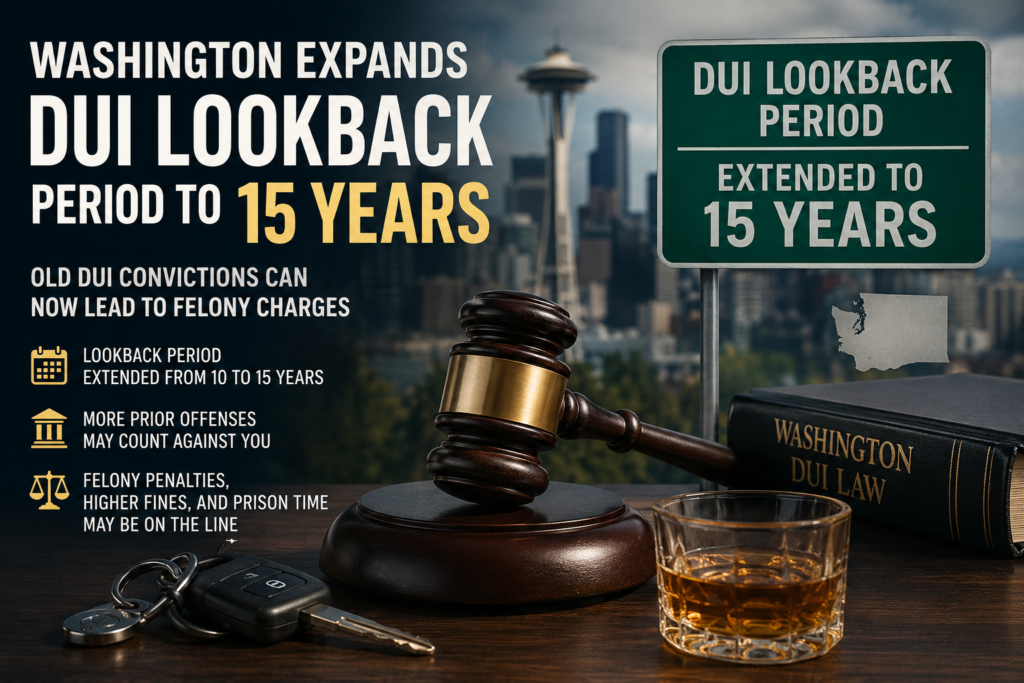
Washington has expanded its DUI “lookback” period from 10 years to 15 years, dramatically increasing the number of repeat offenders who may now face felony-level charges instead of misdemeanor penalties.
And for many people, the most dangerous part is this: offenses they thought were long behind them are suddenly back in play.
If you’re dealing with a new DUI arrest and have any alcohol-related driving history, even from more than a decade ago, the situation may be far more serious than you realize.
Table of Contents
- 1 What Changed Under Washington’s New DUI Law?
- 2 When Does a DUI Become a Felony in Washington?
- 3 The Difference Between a Misdemeanor and a Felony DUI
- 4 The Hidden Problem: Washington Counts More Than Just DUI Convictions
- 5 License Suspension Problems Begin Almost Immediately
- 6 Why Old DUI Cases Suddenly Matter Again
- 7 Challenging the Current DUI Arrest Still Matters
- 8 Deferred Prosecution Changes May Offer Limited Relief
- 9 Why Early Legal Action Matters More Than Ever
- 10 A 14-Year-Old DUI No Longer Feels “Old”
What Changed Under Washington’s New DUI Law?
Washington lawmakers passed House Bill 1493, extending the state’s DUI lookback period from 10 years to 15 years.
That change affects how prosecutors calculate prior offenses when deciding whether a new DUI should remain a gross misdemeanor or escalate into a felony.
Under the previous system, a DUI from 11 or 12 years ago generally fell outside the calculation window. Today, that same conviction can still be counted against you.
The state now examines a full 15-year history when reviewing:
- DUI convictions
- Alcohol-related driving offenses
- Deferred prosecutions
- Certain amended charges
- Out-of-state DUI equivalents
For drivers with older offenses, this change has real consequences. Cases that once would have been handled in local misdemeanor court may now expose defendants to state prison time.
When Does a DUI Become a Felony in Washington?
Not every DUI arrest becomes a felony. But repeat offenses significantly raise the stakes.
Under Washington law, a DUI can become a Class B felony if:
- You have three or more prior offenses within the past 15 years
- You were previously convicted of Felony DUI
- You have a prior Vehicular Homicide or Vehicular Assault conviction involving drugs or alcohol
The jump from misdemeanor to felony status changes nearly everything about the case — sentencing exposure, long-term rights, employment impact, and future criminal history.
The Difference Between a Misdemeanor and a Felony DUI
Many people underestimate how severe felony DUI penalties can become until charges are formally filed.
A gross misdemeanor DUI may involve:
- Up to 364 days in jail
- Court fines
- Probation requirements
- License restrictions
A felony DUI introduces an entirely different level of punishment:
- Potential state prison sentences
- Substantially higher fines
- Long-term supervision requirements
- Permanent felony record implications
Felony convictions can also affect:
- Firearm ownership rights
- Professional licensing
- Employment opportunities
- Housing applications
- Immigration consequences in some situations
For repeat offenders, the legal issue quickly becomes larger than the DUI itself.
The Hidden Problem: Washington Counts More Than Just DUI Convictions
One of the biggest surprises for many defendants is learning what legally qualifies as a “prior offense.”
Washington’s definition is broad.
Even if an earlier DUI was reduced or resolved differently, it may still count against you today.
Reduced Charges Still Matter
Drivers often negotiate DUI arrests down to lesser charges such as:
- Reckless Driving
- Negligent Driving First Degree
- Physical Control
Many assume those outcomes erase the DUI risk permanently.
They do not.
If alcohol or drugs were involved in the original case, prosecutors can still count those amended charges as prior offenses under the 15-year rule.
Deferred Prosecutions Still Follow You
Deferred prosecution programs are another area where confusion happens frequently.
A driver may complete treatment requirements successfully and avoid a conviction, but the deferred prosecution itself can still count as a prior offense later.
That means someone who believed they “avoided” a DUI years ago may still face enhanced penalties after a new arrest.
Out-of-State DUIs Can Be Used Against You
Washington prosecutors are also allowed to examine prior convictions from other states.
If another state’s DUI law is considered substantially similar to Washington’s statutes, prosecutors may attempt to use that conviction toward felony enhancement calculations.
This becomes especially important for people who moved to Washington years after prior arrests elsewhere.
License Suspension Problems Begin Almost Immediately
The criminal case is only one part of the problem.
Washington’s Department of Licensing (DOL) runs a separate administrative process after a DUI arrest, and deadlines arrive fast.
Many drivers do not realize:
- License suspension can begin before criminal conviction
- You only have a limited window to request a hearing
- Prior offenses affect suspension length
- Ignition interlock requirements may become much longer under repeat offense calculations
Missing the administrative deadline can create major driving restrictions even before the criminal case moves forward.
Why Old DUI Cases Suddenly Matter Again
The expanded lookback period creates a unique issue for repeat offenders: old cases must now be reexamined carefully.
An experienced DUI defense attorney of Washington will often review:
- Whether prior convictions were legally valid
- Whether constitutional rights were violated previously
- Whether out-of-state convictions truly qualify under Washington law
- Whether prior plea agreements were entered properly
This matters because removing even one prior offense from the calculation can dramatically change the outcome of the current case.
In some situations, reducing the prior count may prevent a felony filing entirely.
Challenging the Current DUI Arrest Still Matters
Even if prior offenses exist, the present arrest must still be proven properly.
Strong DUI defense work often involves reviewing:
- The legality of the traffic stop
- Officer observations and field sobriety procedures
- Breath or blood testing accuracy
- Maintenance and calibration records for testing equipment
- Constitutional rights during questioning or detention
A repeat offense case may feel overwhelming, but prosecutors still carry the burden of proving the current allegations lawfully and accurately.
That process creates opportunities for defense strategy.
Deferred Prosecution Changes May Offer Limited Relief
While Washington expanded DUI penalties, some recent legal updates also adjusted deferred prosecution eligibility rules.
Under specific conditions, certain individuals may qualify for another deferred prosecution opportunity even if they previously used one years ago.
These situations are highly fact-specific and depend heavily on:
- Prior case history
- Timing
- Treatment eligibility
- Current charges
Still, for some defendants facing potential prison exposure, this option may provide an alternative path focused on treatment instead of incarceration.
Why Early Legal Action Matters More Than Ever
With Washington aggressively expanding repeat offender penalties, waiting too long to hire legal counsel can become a costly mistake.
The prosecution begins building its timeline immediately:
- Reviewing prior records
- Pulling driving history
- Evaluating enhancement eligibility
- Coordinating with the Department of Licensing
Early defense intervention allows attorneys to identify weaknesses before felony charges fully solidify.
That timing can influence negotiations, licensing outcomes, and even charging decisions themselves.
A 14-Year-Old DUI No Longer Feels “Old”
That’s the reality many Washington drivers are now facing.
A conviction from more than a decade ago — something people assumed was buried in the past — can suddenly become the foundation for a felony prosecution carrying prison exposure and permanent consequences.
The state’s expanded 15-year lookback rule changed the legal terrain dramatically.
If you’re facing a repeat DUI allegation, the issue is no longer just the current arrest. It’s how your entire driving history now gets pulled back into the conversation.