





The global energy sector stands at the edge of one of the most consequential transformations in its history. Over the next two decades, the industry will be shaped by the convergence of climate policy, technological innovation, shifting consumer demand, and geopolitical realignment. While fossil fuels have powered economic growth for more than a century, the coming twenty years will likely mark a decisive pivot toward diversified, decentralized, and increasingly electrified energy systems. Understanding where the sector is headed requires looking closely at the forces driving change and the challenges that could slow or accelerate that transition.
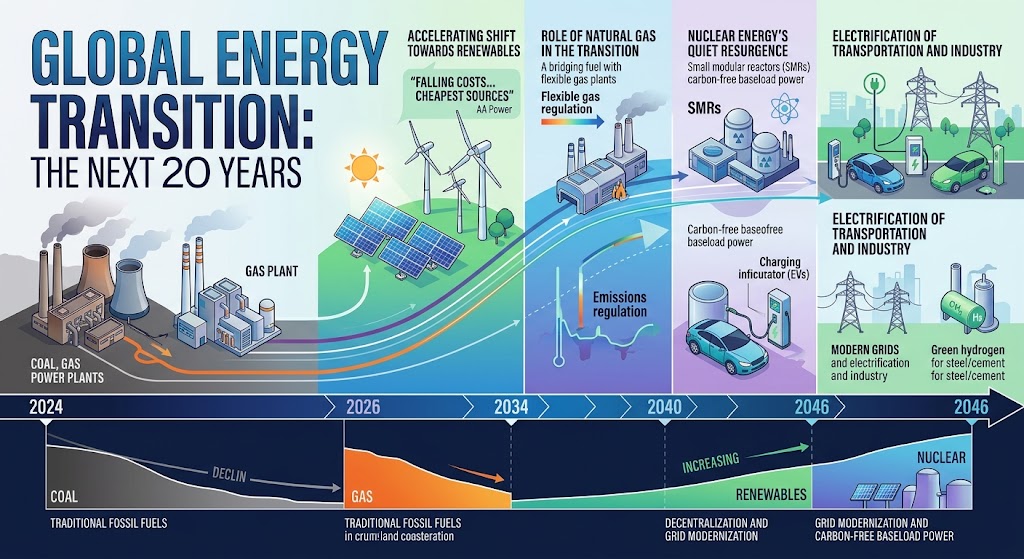
The Accelerating Shift Toward Renewables
Renewable energy has moved from the margins of the power sector to its center. Solar and wind capacity additions have outpaced fossil fuel capacity growth in many major economies for several consecutive years, and this trend shows no sign of reversing. “Falling costs have been the primary catalyst: the price of utility-scale solar has dropped dramatically since 2010, making it one of the cheapest sources of new electricity generation in most regions of the world.”, as mentioned by AA Power.
Over the next twenty years, analysts widely expect renewables to account for the majority of new power generation capacity worldwide. Grid operators are increasingly investing in smart grid technology to manage the variability that comes with wind and solar output, and utility companies are rethinking long-term infrastructure planning around distributed generation rather than centralized power plants alone. This shift is not merely environmental; it has become an economic necessity, as mentioned by AA Power, since renewable projects now frequently deliver electricity at lower long-term costs than new coal or gas plants in many markets.
The Role Of Natural Gas In The Transition
Even as renewables expand, natural gas is expected to remain an important part of the energy mix for at least the next decade, functioning as a bridge fuel that offers flexibility that intermittent renewables cannot always provide on their own. Gas-fired plants can ramp production up or down quickly, making them valuable partners to wind and solar farms during periods of low output. However, the long-term outlook for natural gas is far less secure than it was ten years ago. Stricter methane emissions regulations, growing investor scrutiny of fossil fuel assets, and the declining cost of battery storage are all working against gas’s dominance. By the 2040s, many forecasts suggest gas will play a smaller supporting role, primarily used for peak demand periods and industrial applications rather than baseload power.
Nuclear Energy’s Quiet Resurgence
Nuclear power, long sidelined due to high construction costs and public skepticism following past accidents, is experiencing renewed interest. Several governments have reversed prior decisions to phase out nuclear plants, recognizing that nuclear energy provides reliable, carbon-free baseload power that renewables alone struggle to match. Small modular reactors, which promise lower upfront costs and shorter construction timelines than traditional large-scale plants, are drawing significant investment and could become commercially viable within the next ten to fifteen years. If these technologies mature as expected, nuclear could account for a meaningfully larger share of global electricity generation by the 2040s than it does today.
Electrification Of Transportation And Industry
One of the most significant demand-side shifts shaping the energy sector’s future is electrification. Electric vehicles, which represented a small fraction of global auto sales just a decade ago, now make up a rapidly growing share of new vehicle purchases in many countries. This trend is expected to continue accelerating as battery costs fall further and charging infrastructure expands. The implications for the power grid are substantial: widespread EV adoption will significantly increase electricity demand, requiring utilities to invest heavily in grid capacity and modernization.
Beyond transportation, heavy industry is also beginning to electrify processes that have traditionally relied on fossil fuels, including steelmaking and cement production. Hydrogen, particularly green hydrogen produced using renewable electricity, is emerging as a promising solution for industries that are difficult to electrify directly. While hydrogen infrastructure remains in its early stages, billions of dollars in investment are flowing into pilot projects and production facilities, suggesting the technology could play a meaningful role in the energy mix by the 2040s.
Geopolitical And Policy Uncertainty
The pace of the energy transition will not be determined by technology and economics alone. Government policy, trade relationships, and geopolitical stability will heavily influence how quickly the sector evolves. Tariffs on solar panels and battery components, disputes over critical mineral supply chains, and shifting political priorities can all slow progress or redirect investment. Countries rich in lithium, cobalt, and rare earth elements will likely gain increasing strategic importance, potentially reshaping global alliances in ways reminiscent of oil-producing nations’ influence in the twentieth century.
Preparing For A More Complex Energy Landscape
The next twenty years will not bring a clean, linear transition from fossil fuels to renewables. Instead, the energy sector is likely to become more complex, with multiple technologies coexisting and competing for investment, infrastructure, and policy support. Companies and consumers alike will need to adapt to an energy landscape defined by decentralization, digitalization, and volatility. Utilities that invest early in grid modernization, storage capacity, and diversified generation portfolios will be best positioned to navigate the uncertainty ahead.
While no forecast can predict every twist in the road, the broad trajectory is increasingly clear: renewables will dominate new capacity growth, electrification will reshape demand patterns, and traditional fossil fuel sources will play a diminishing but not entirely disappearing role. The energy sector of 2046 will look markedly different from today’s, shaped by decisions being made right now in boardrooms, legislatures, and research labs around the world.
