



With the rise of Uber and Lyft, ridesharing has become a key mode of transportation in Nevada cities like Las Vegas and Reno. While these services offer convenience, they can also lead to confusion and frustration in the aftermath of an accident. Understanding insurance coverage in Nevada rideshare accident cases is vital for both passengers and drivers. Insurance rules for rideshare accidents differ from those in regular car crashes. The process can quickly get complicated, especially when both a personal insurance policy and a rideshare company’s commercial insurance may be involved. If you find yourself injured after an incident involving a rideshare vehicle, knowing your legal options after an Uber or Lyft crash in Las Vegas can make all the difference for your recovery.
In Nevada, rideshare accident insurance is governed by both state law and company policies, and the coverage available often depends on the driver’s activity at the time of the collision. Exploring how different insurance policies interact can help accident victims pursue compensation confidently and efficiently. This article will break down the major types of insurance coverage, explain how they apply during various stages of a rideshare trip, and provide practical advice for handling insurance after a crash. Being prepared with this knowledge can help you avoid costly mistakes and ensure your rights are protected.
Table of Contents
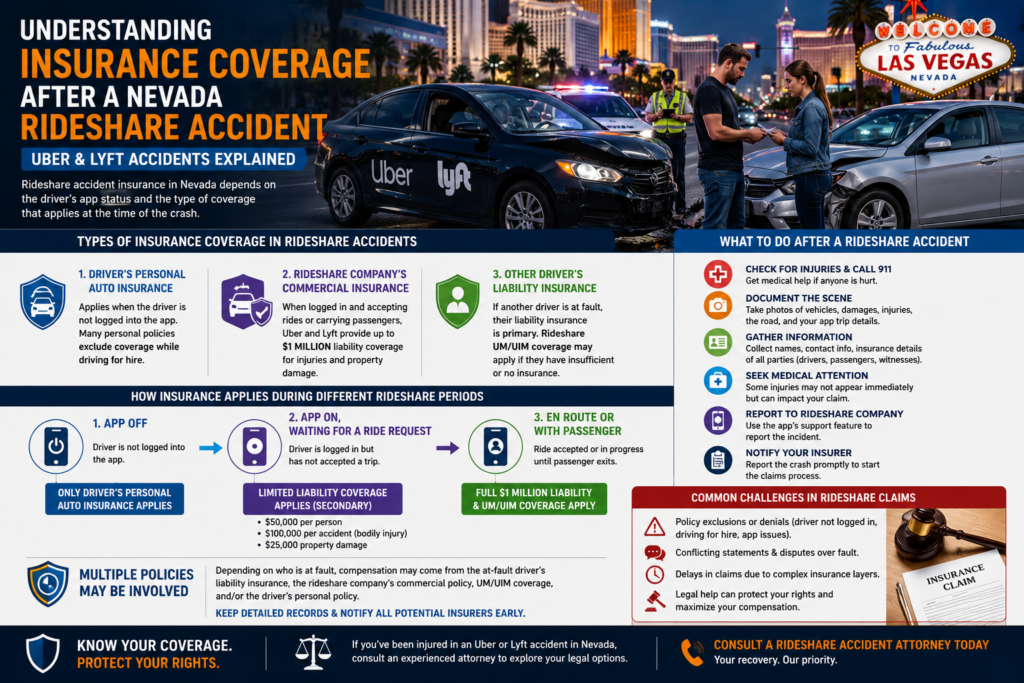
Three main types of insurance may be relevant after a rideshare accident in Nevada:
- The driver’s personal auto insurance: This policy usually applies when the driver is not logged into their rideshare app. However, many personal auto insurance plans contain exclusions for accidents that occur while driving for hire. It is important to check if your policy covers rideshare activity or if a special add-on is required.
- The rideshare company’s commercial insurance: When a driver is logged in and accepting rides or carrying passengers, the rideshare company’s insurance generally steps in. Nevada law requires companies like Uber and Lyft to provide liability coverage of at least $1 million when a passenger is in the vehicle, which covers injuries and property damage caused by the driver’s negligence.
- Other driver’s liability insurance: If another motorist is at fault, their liability insurance could be the first source of compensation. In such instances, the rideshare company’s uninsured or underinsured motorist (UM/UIM) coverage might also become involved if the at-fault driver has inadequate insurance.
Rideshare policies are designed to fill gaps when a personal insurer denies coverage, a common scenario if the accident occurred during paid driving.
The period during which the accident occurs determines which insurance policy applies. Nevada recognizes three distinct periods in the rideshare process:
- App Off: The driver is not logged into the rideshare app. In this period, only the driver’s personal auto insurance is active.
- App On, Waiting for a Ride Request: The driver is logged in but has not yet accepted a trip. Rideshare companies provide limited liability coverage (minimum $50,000 per person and $100,000 per accident for bodily injury, and $25,000 for property damage), usually as secondary coverage if the personal policy denies the claim.
- En Route or With Passenger: Once a ride is accepted or underway, the rideshare company’s full $1 million liability policy and UM/UIM coverage are in effect until the passenger exits the vehicle. This provides broad protection for passengers and third parties injured in an accident involving the rideshare vehicle.
These insurance stages are crucial to understanding what to expect if you are involved in a rideshare accident, as outlined by NerdWallet’s rideshare insurance guide.
Handling Multiple Insurance Policies
Multiple policies may be triggered in a single Nevada rideshare accident. For example, if you are a passenger injured in a crash caused by another driver, you would first turn to the at-fault motorist’s liability insurance. If their coverage is too low or the driver is uninsured, the rideshare company’s commercial UM/UIM coverage may be available.
Navigating these overlapping insurance layers requires clear documentation and early notification of all potential insurers. Always gather the driver’s insurance details (both personal and commercial) and keep copies of the rideshare app’s records of your trip.
- Check yourself and others for injuries and call 911 if anyone is hurt.
- Document the scene by taking photos of all vehicles, the street, visible injuries, and the rideshare app screen showing your trip details.
- Gather contact and insurance information for all parties (riders, drivers, and any third parties involved).
- Seek immediate medical attention, as some symptoms may take time to appear but can significantly influence an insurance claim.
- Contact the rideshare company through the app’s support feature to report the incident officially.
Promptly reporting the crash to your insurance company and the rideshare platform will help preserve evidence and initiate the claim process promptly.
Rideshare accident claims in Nevada can be complicated by insurance policy exclusions, conflicting statements, and difficulties proving fault. In some cases, insurers may dispute coverage, arguing that the driver was not logged in or that a technical issue with the app prevented coverage. These hurdles can delay compensation or lead to denied claims. It is important to keep detailed records, act quickly, and seek legal assistance if you face obstacles. Working with an attorney familiar with rideshare laws gives victims a strong chance to recover the compensation they need for medical bills, lost wages, and pain and suffering.
Conclusion
Insurance coverage for rideshare accidents in Nevada combines both personal and commercial policies, with the details depending on the driver’s status in the app and who caused the crash. Understanding these nuances and acting quickly after a rideshare accident can make all the difference in securing fair compensation. Stay informed, gather evidence, and use all available resources, including experienced legal support, to protect your rights after a rideshare accident in Nevada.