




Modern distribution centers are at the heart of a new era in supply chain management, leveraging advanced technologies and innovative strategies to redefine how goods move from manufacturers to customers. This evolution is not just about speed, but also about accuracy, sustainability, and flexibility. Today’s facilities are designed to meet the ever-increasing expectations for faster, more reliable deliveries while optimizing operational efficiency. As a result, companies are turning to specialized partners, such as a warehouse construction company, to ensure their distribution centers support these emerging requirements.
By adopting transformative tools and best practices, businesses can lower costs, reduce delays, and improve customer satisfaction. Key innovations such as automation, artificial intelligence, management systems, and environmentally conscious designs contribute to this transformation, facilitating seamless operations that adapt to fast-changing market dynamics and consumer needs.
Modern distribution centers have evolved beyond mere storage facilities, now functioning as high-performance hubs that efficiently manage inventory flow, order fulfillment, and returns. Through strategies such as strategic location planning, sustainable practices, and omnichannel fulfillment, these centers provide businesses with a competitive advantage.
This comprehensive transformation affects every aspect of the supply chain, requiring organizations to adapt quickly to remain efficient and relevant. Companies that invest in advanced facilities and technologies experience significant gains in agility and customer loyalty.
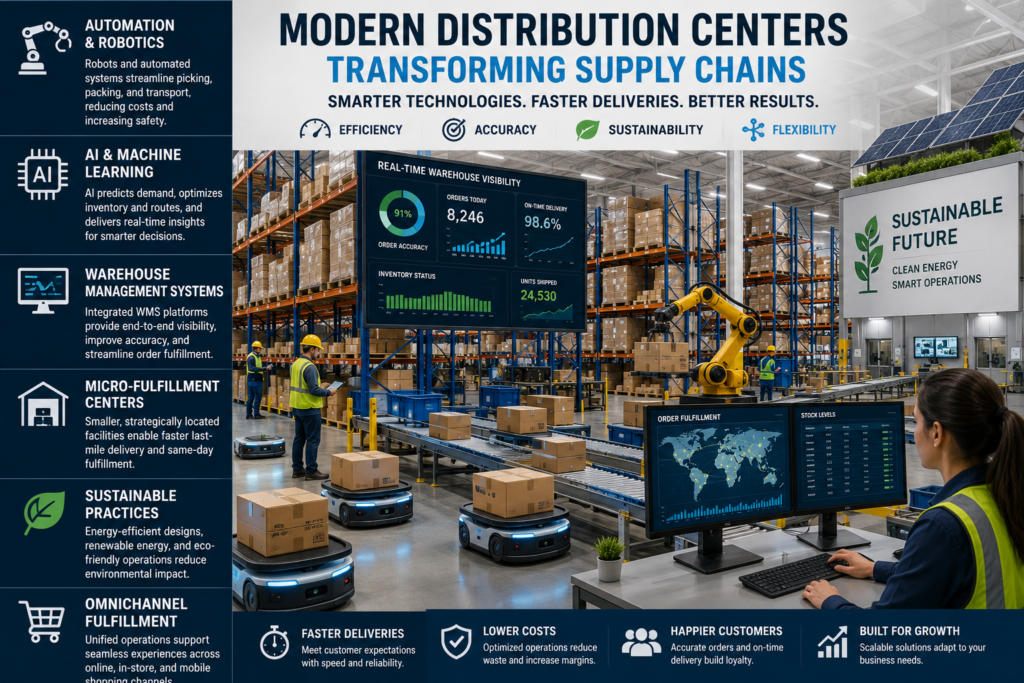
Table of Contents
Automation and Robotics
The integration of automation and robotics has redefined the operational blueprint of distribution centers. Automated conveyor systems, mobile robots for goods transport, and robotic arms for picking and packing have collectively reduced errors and labor costs. By handling repetitive and physically demanding tasks, these systems speed up operations, ensure safety, and allow human workers to focus on more complex responsibilities.
Major retailers, such as Walmart, are investing heavily in automating distribution centers. These investments are expected to peak over the next two years as companies seek to improve efficiency and lower operational costs. Automation has become synonymous with scalability in the warehouse sector, aligning with global logistics trends.
AI and Machine Learning
The impact of Artificial Intelligence and Machine Learning in distribution centers is profound. These technologies bring unprecedented precision to demand forecasting, inventory management, and route optimization. AI-powered systems analyze historical data and current market trends to predict stock requirements more accurately than traditional methods, helping reduce excess inventory, avoid stockouts, and minimize waste.
Advanced analytics tools enhance supply chain visibility and responsiveness, enabling businesses to adapt quickly to demand fluctuations. For example, large-scale retailers employ AI for real-time monitoring to anticipate shifts in buying behavior and optimize warehouse stock levels, significantly bolstering their fulfillment capabilities.
According to Forbes, AI applications in warehouses are elevating productivity while reducing human intervention for routine decision-making tasks, marking a critical advance in modern logistics operations.
Warehouse Management Systems
Modern Warehouse Management Systems connect the dots across complex supply chains, integrating logistics, procurement, and fulfillment operations into a single unified platform. Real-time data and actionable analytics are available on demand, supporting dynamic decision-making and immediate problem resolution. These systems elevate inventory accuracy, streamline order processing, and support both brick-and-mortar and online commerce from a consolidated infrastructure.
For instance, Levi’s has consolidated its distribution network with advanced warehouse management, increasing its ability to fulfill both retail and digital orders from a central operation. The move toward unified WMS solutions is a growing trend as companies realize the efficiency gains from aggregated logistics flows and cross-channel support. According to Supplychain360, Levi’s is redesigning its U.S. distribution network to serve both stores and online orders from a unified system.
Micro-Fulfillment Centers
Faster delivery expectations have driven the rise of micro-fulfillment centers, strategically located in or near urban hubs. These smaller warehouses leverage automation, AI, and innovative layouts to cut last-mile delivery times and support same-day or next-day delivery promises. Companies like The Home Depot are expanding micro-fulfillment operations to bring products closer to customers, responding directly to shifts in online shopping behavior and demand for rapid turnaround. According to The Home Depot, the company is opening four new distribution centers to better serve pro customers.
The micro-fulfillment trend is accelerating as retailers and logistics providers race to outpace competitors in urban areas. By ensuring goods are located close to high-density areas, businesses can meet customer expectations and lower overall transportation costs, thereby driving efficiency throughout their distribution networks.
Sustainable Practices
The growing focus on environmental stewardship is reshaping how distribution centers are designed and operated. Energy efficiency, use of renewable power sources, and eco-friendly materials now define next-generation warehouse facilities. Integrating solar panels, LED lighting, recyclable packaging, and electric vehicle fleets not only helps reduce the carbon footprint but also satisfies strict regulatory requirements and aligns with consumer preferences for green business practices.
Several leading companies are setting the standard by transparently reporting sustainability metrics and establishing ambitious goals for carbon reduction. These eco-initiatives are not only good for the planet but also make sound business sense by optimizing resource consumption and building customer trust.
Omnichannel Fulfillment
Omnichannel fulfillment integrates online and offline sales channels to enhance the customer experience, requiring sophisticated inventory management and real-time visibility across all sales points. By employing flexible distribution networks, businesses can simultaneously serve brick-and-mortar and e-commerce customers.
Furthermore, modern distribution centers are transforming global supply chains by adopting cutting-edge technologies and sustainable practices. Their evolving role is crucial for developing resilient, efficient, and customer-focused supply chains, positioning companies that invest in these innovations for success in a competitive market.
Conclusion
Modern distribution centers are evolving into highly intelligent, technology-driven hubs that power efficient and customer-focused supply chains. By integrating automation, AI, advanced warehouse management systems, micro-fulfillment strategies, and sustainable practices, businesses can improve accuracy, reduce costs, and meet growing consumer demands for faster delivery and seamless omnichannel experiences. As logistics continues to evolve, companies that invest in innovation and adaptability will be better positioned to build resilient operations and maintain a competitive edge in the global marketplace.